
Basement Wall Crack Repair: What Different Crack Patterns Mean
Not every crack in a basement wall is an emergency, but some cracks are a direct sign the wall is under stress. The direction of the crack, its width, whether it’s growing, and whether the wall is still flush all point to different causes and different repair approaches. If you’re seeing cracks that are widening, repeating, or paired with wall movement, an inspection is the fastest way to confirm the cause and prevent it from getting worse.
Quick warning signs (call for an evaluation):
- Cracks that are widening over time
- Cracks where one side is offset (no longer flush)
- Any horizontal crack in a basement wall
- Multiple stair-step cracks on one wall, or stair-step cracks crossing
- A wall that looks bowed, bulging, leaning, or tipping (even without cracks)
Get Your Free Estimate
Tell us what you’re seeing. We’ll call to set up a free inspection.
Vertical Cracks in Basement Walls
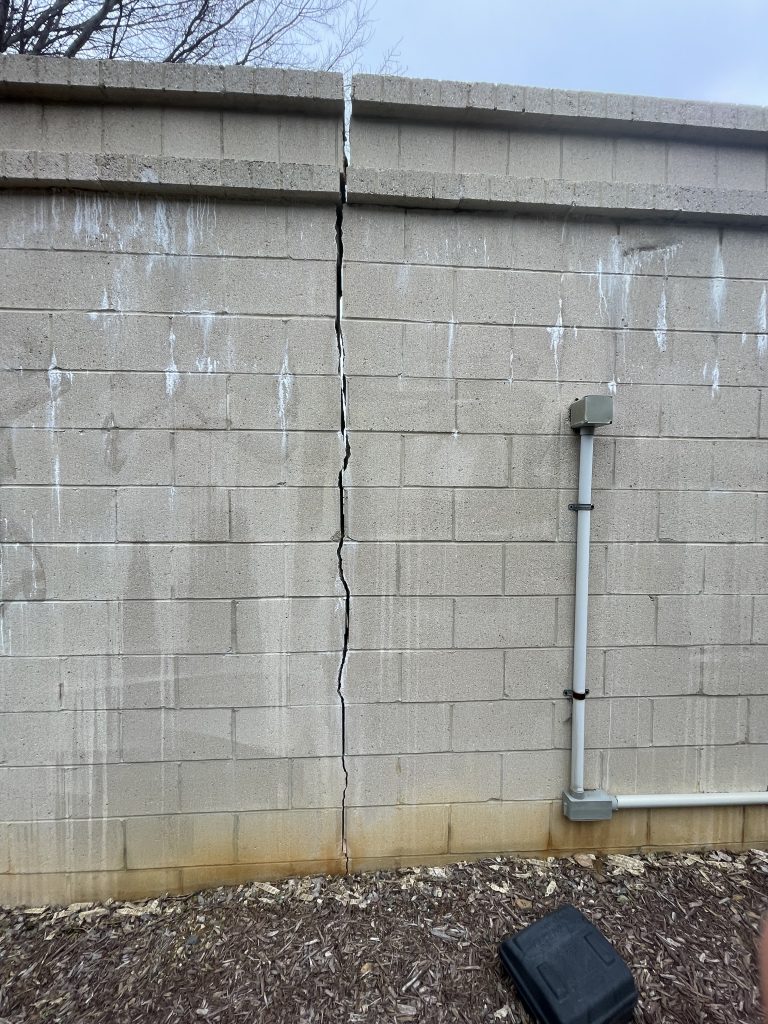
Especially in a poured concrete or long block wall small horizontal cracks are common. Concrete expands and contracts with temperature and moisture changes. Residential basement walls usually don’t include expansion joints, so minor vertical cracking can occur.
When vertical cracks are often not a concern
- Thin, consistent crack
- Both sides of the wall stay flush
- The crack does not widen significantly over time
- Cracks are spaced out (not clustered)
When vertical cracks become a concern
- Cracks appear at closer intervals than expected (more cracking than normal)
- The crack is wider at the top or bottom than the middle (can indicate uneven movement/settlement)
- The crack is offset (one side shifted inward/outward), suggesting the wall may be starting to lean
Horizontal Cracks in Basement Walls (High Priority)
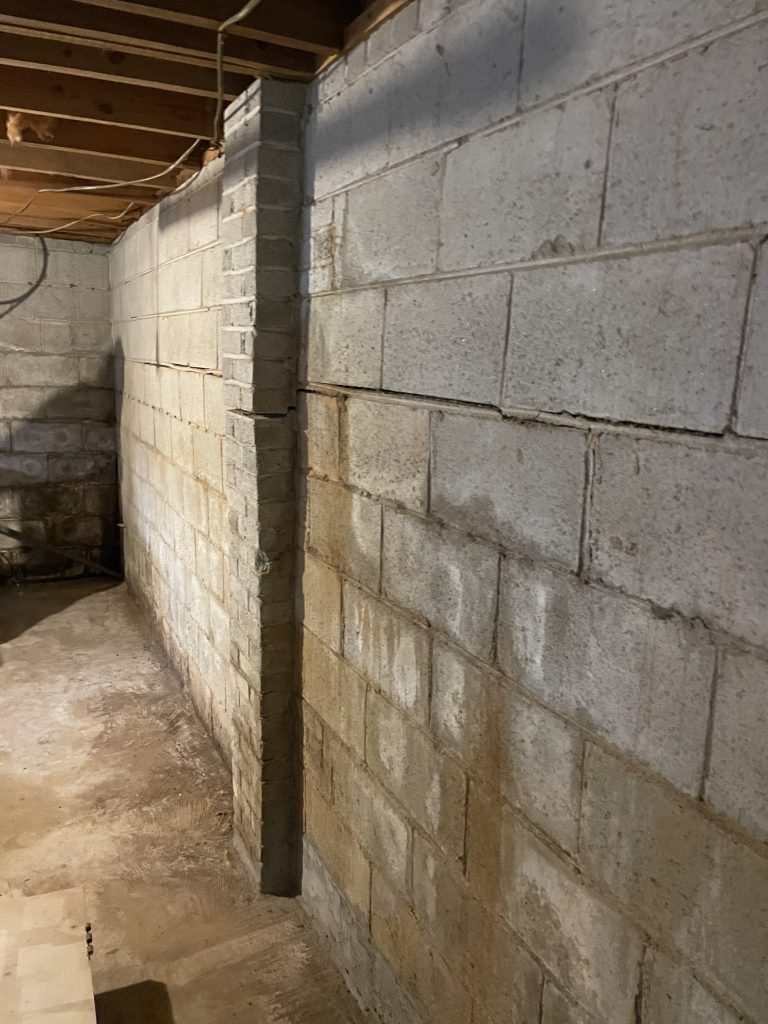
Horizontal cracks are one of the most serious signs a basement wall can show. A crack running horizontally, at any height, often indicates the wall is failing under lateral soil pressure pushing inward from the outside. Soil pressure increases significantly when saturated (heavy rain, poor drainage, freeze-thaw cycles). Over time, pressure can exceed what the wall can resist, causing inward bowing—and the horizontal crack is the visible evidence.
Note: A horizontal crack should always be evaluated promptly.
Early stabilization usually provides more options and lower cost than waiting.
Stair-Step Cracks in Block Walls (and Diagonal Cracks in Poured Walls)
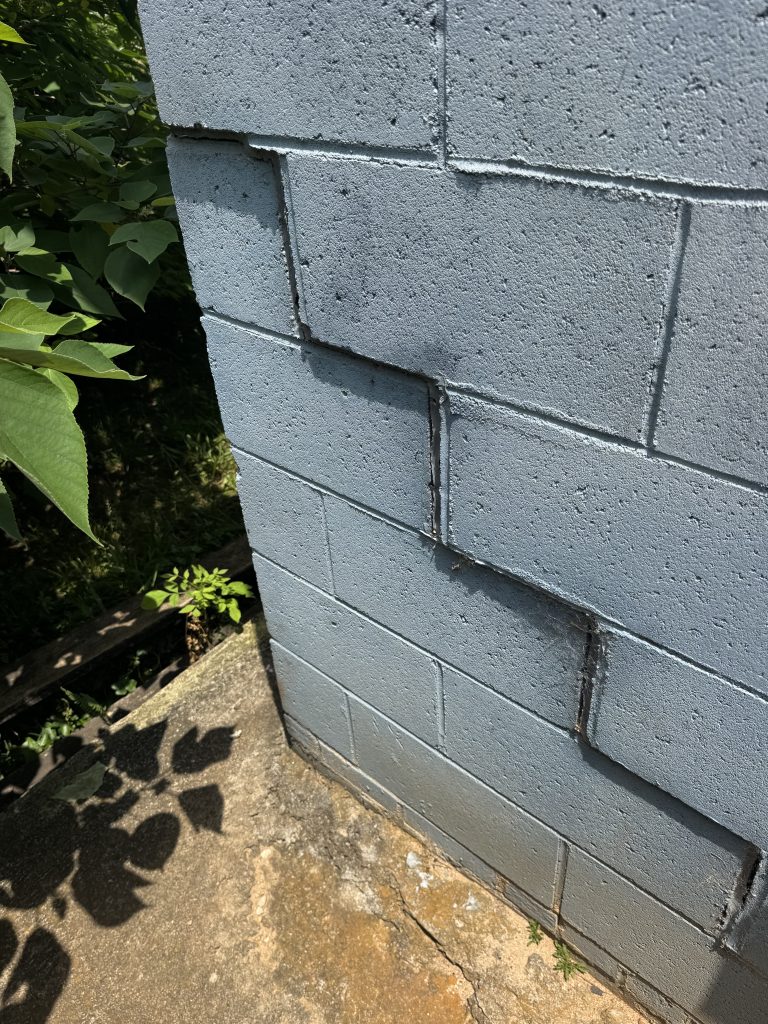
Cracks following the mortar joints in a block wall in a stair stepping diagonal pattern or a diagonal crack in a poured wall are often a sign that an area is sinking or settling. The area “under the stairs” is typically the portion that has seen the settlement.
What stair-step cracks often indicate:
Settlement: the soil beneath a section of wall/footing compresses or washes out, causing one area to sink relative to the rest.
When stair-step cracks are more serious
- Multiple stair-step cracks on the same wall
- Stair-step cracks that cross in opposite directions
- These patterns can indicate lateral pressure and wall movement, not just settlement, and should be treated with the same urgency as a horizontal crack.
Leaning Without Cracking (Still Serious)
Sometimes a basement wall can begin to lean inward without a clear crack pattern across the wall face. In these cases, the wall may be failing at the connection point where it meets the structure above and tilting inward as a unit. If the wall looks out of plumb, even slightly, this should be promptly be evaluated.
Learn more about leaning wall repair here.
Schedule a Basement Wall Crack Evaluation
If you’re seeing a horizontal crack, widening cracks, offset cracks, or any sign of bowing/leaning, get it inspected before the problem grows.
Basement Wall Crack Repair FAQs
Can a basement wall lean without cracking?
Yes. A wall can tilt inward at the top connection without an obvious crack pattern.
Why do cracks come back after repair?
If the wall is still moving, cosmetic patching can fail. Stabilization may be needed.
What do stair-step cracks mean in a block basement wall?
Often settlement, but multiple or crossing stair-step cracks can indicate pressure and movement.
Is a horizontal crack in a basement wall dangerous?
It can be. Horizontal cracks often indicate lateral pressure and wall movement and should be evaluated promptly.
Are vertical cracks in basement walls normal?
Some thin, flush vertical cracks can be normal. Widening or offset cracks should be inspected.
Serving the Upstate of South Carolina
Foundation and crawl space repair across twelve counties of the Upstate and beyond. Hover a city to see it on the map. Not listed? Call and ask. If we don't cover you, we'll tell you straight.